Execution Context
Execution Context is the environment in which JavaScript code is evaluated and executed.
Every time JavaScript runs code, it does so inside an execution context.
At any moment:
- Only one execution context is active
- It always sits on top of the Call Stack
Types of Execution Context
JavaScript has two main execution contexts:
- Global Execution Context (GEC)
- Function Execution Context (FEC)
Global Execution Context (GEC)
- Created once when the JavaScript file starts executing
- In a browser, typically only ONE GEC is created per JavaScript realm (page/window)
- Represents code not inside any function
- Sits at the bottom of the call stack
Two Phases of GEC
Memory Creation Phase
Before executing a single line of code, JavaScript:
- Allocates memory
- Sets up scope
During this phase:
varvariables → initialized asundefined- Function declarations → fully hoisted
let&const→ allocated but not initializedthis→ points to the global object (browser:window)
Code Execution Phase
- JavaScript executes code line by line
- Variables get actual values
- Functions are invoked
Example
var a = 10;

function foo() {
  console.log("Hello");
}

foo();
Memory Creation Phase:
a→undefinedfoo→ function reference
Execution Phase:
a→10foo()is invoked
Function Execution Context (FEC)
- Created every time a function is called
- Each function call gets a new execution context
- Pushed onto the call stack
- Destroyed after function finishes execution
Two Phases of FEC
Memory Creation Phase
- Function arguments are assigned
- Local variables are allocated
- Inner function declarations are hoisted
thisis determined (based on how function is called)
Code Execution Phase
- Function body executes line by line
- Values are assigned
- Nested function calls create more execution contexts
Example
function add(x, y) {
  var result = x + y;
  return result;
}

add(2, 3);
Inside add execution context:
x→2y→3result→undefined(creation phase)result→5(execution phase)
How GEC and FEC Work Together
- Global Execution Context is pushed first
- Each function call:
- Creates a new Function Execution Context
- Pushes it onto the call stack
- When function returns:
- Its execution context is popped off the stack
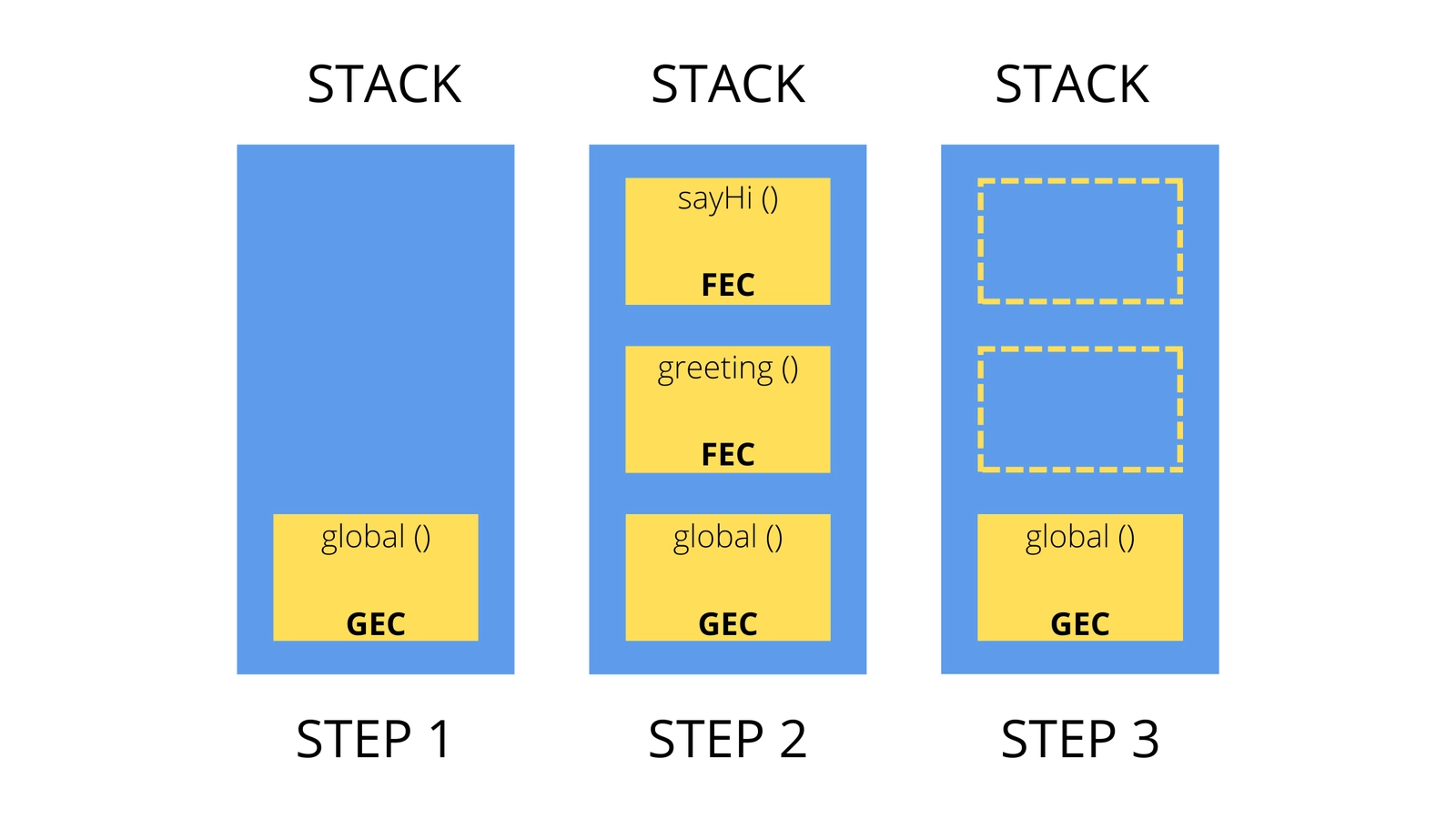
- Step 1: Only the Global Execution Context (GEC) is on the stack
- Step 2:
greeting()is called and gets its own FEC, then it callssayHi(), which gets another FEC on top - Step 3:
sayHi()and thengreeting()finish and are popped off, leaving only the GEC
Call Stack Example
function one() {
  two();
}

function two() {
  three();
}

function three() {
  console.log("Done");
}

one();
Call Stack flow:
- Global Execution Context
one()Execution Contexttwo()Execution Contextthree()Execution Contextthree()completes → poppedtwo()completes → poppedone()completes → popped
Common Interview Clarifications
- Execution Context ≠ Call Stack
- Execution context is what
- Call stack is where
- Only one execution context executes at a time
- Execution contexts are created synchronously
- Async callbacks create new execution contexts later
Common Misconceptions
❌ "Execution context is created for every line" ✅ Created only for global code and function calls
❌ "Async code runs in the same execution context" ✅ Async callbacks run in new execution contexts
❌ "Hoisting happens during execution" ✅ Hoisting happens during memory creation phase
What is an Execution Context Physically?
An execution context is:
- A C++ object / struct
- Allocated in native memory (heap)
- Created and destroyed by the JS engine (e.g. V8)
- Referenced by the call stack
Conceptual representation:
// Conceptual (NOT real V8 code)
struct ExecutionContext {
  LexicalEnvironment* lexicalEnv;
  VariableEnvironment* variableEnv;
  ThisBinding thisValue;
  CodePointer* instructionPointer;
};
Where Does It Live?
- Execution contexts live in engine-managed memory
- Not accessible from JavaScript
- Not visible in DevTools
- Exist only while code is executing
The Call Stack is essentially a stack of pointers to these execution context objects:
Call Stack (native memory)
┌─────────────────────────┐
│ Pointer → EC for foo()  │
│ Pointer → EC for bar()  │
│ Pointer → Global EC     │
└─────────────────────────┘
Key Takeaway
Execution context explains where variables live and how JavaScript executes code step by step.